August 11, 2026 · By the DataForge team
DataForge 10.3 Opens the Platform to Your AI Agents
DataForge 10.3 ships the DataForge MCP server, so external AI agents can build and operate complete pipelines under save-time validation.
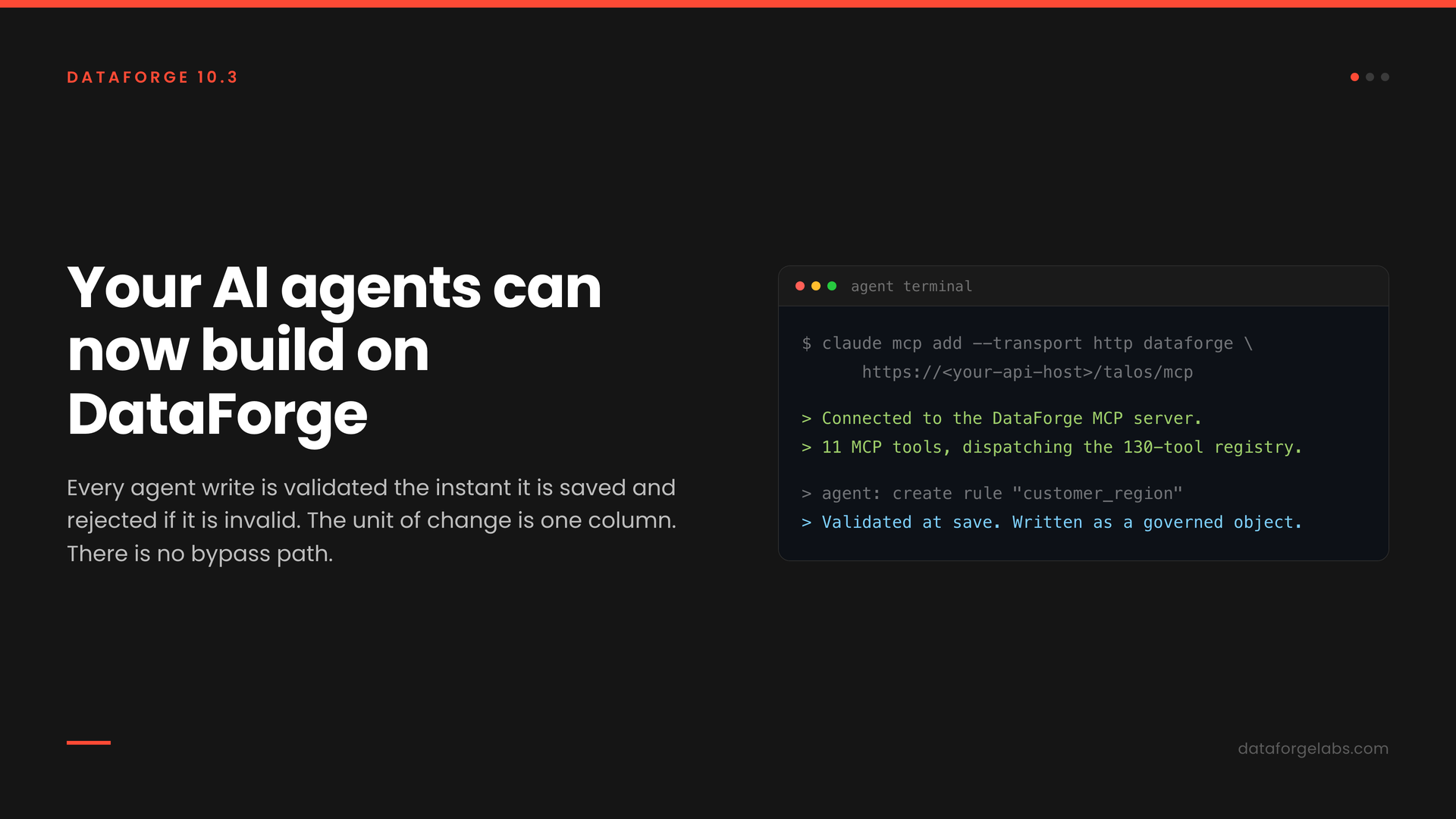
DataForge, the AI-powered declarative data platform for modern data teams, has released DataForge 10.3, and with it the DataForge MCP server. External AI agents can now build and operate complete data pipelines inside DataForge as governed platform objects, running on the customer’s own Databricks or Snowflake compute.
DataForge 9.0 introduced Talos, the in-product AI assistant. 10.3 opens the platform to your agents. The same 148-tool registry that powers Talos is now served to any MCP client, with identical validation, permissions, and telemetry. 10.3 also adds AI SQL conversion, a new lineage experience, and automap.
“DataForge 9.0 gave our users an AI assistant inside the product,” said Matt Kosovec, CEO of DataForge. “10.3 gives their own agents a door into the platform. An agent working in Claude Code or Codex can connect a source, write the rules, run the pipeline, and deliver the output, and every write it makes is checked exactly the way a person’s edit is checked.”
What the MCP Server Does
The DataForge MCP server is a hosted, OAuth-authenticated remote MCP server. Claude Code and Codex are the documented clients, and because the server implements standards-based OAuth 2.1 with PKCE and dynamic client registration, any compliant MCP client can connect.
As of July 2026, based on public vendor documentation, DataForge is the only declarative data engineering platform whose MCP server lets an external AI agent (Claude Code, Codex, Cursor) directly build and operate the complete pipeline lifecycle (ingestion, transformation, orchestration, and delivery) as governed platform objects running natively on customer-owned Databricks or Snowflake compute, with every write passing the same save-time validation as a human edit.
Validation at Save Time, Not at Run Time
Every AI-agent write through DataForge’s MCP server (across all 148 tools, from ingestion config to individual column rules) passes the exact same save-time validation as a human edit in the UI: schema checks, SQL expression parsing, and role-based permissions on every call. Invalid changes never persist. The agent gets back a structured error with the line and column of the problem, the exact next call to make, and when to retry, so it fixes its own mistake in seconds instead of discovering it when the pipeline runs.
In DataForge, AI agents get no privileged path and no forgiving one. Every agent write goes through the same parse-and-save validation as a human edit: same expression parser, same schema constraints, same database-enforced permissions checked on every call, same confirmation gates on destructive actions. An invalid agent write is rejected at save with the same errors a human would see, plus machine-readable recovery instructions. No bypass mode, no reduced validation for AI.
Guardrails Built for Agents
DataForge’s MCP server is the only data engineering platform MCP we have found (public vendor documentation, July 2026) that combines all four of these guardrails in one surface: sequencing guards that answer a too-early request with “not ready yet, retry in N seconds” so agents never build against schemas that do not exist; cost guidance that steers agents away from expensive re-ingestion; destructive-action confirmation enforced server-side; and role-based permissions checked in the database on every tool call. Competitors ship pieces. None ships all four, and none ships sequencing guards at all.
The Operating Manual Ships With the Release
As of July 2026, based on public vendor documentation, DataForge is the only data engineering platform whose hosted MCP server serves the agent’s complete operating manual from the deployed release itself: the agent guide, the object taxonomy, the status-code dictionary, and the SQL conversion cookbook. The manual ships inside the product and is versioned with every release, so the instructions an agent reads always match the exact version it is operating. There are no separately installed doc bundles that go stale, and no live doc-site searches describing a different version than the one you run.
What Ships in 10.3
The registry behind the MCP server holds 148 tools: 79 read-only, 69 write, 18 flagged destructive, and 7 low-level tools hidden from default discovery. Rather than hand a client 148 schemas at connection time, the server presents a 12-tool surface: 5 discovery meta-tools, 3 project-session tools, and 4 instruction-serving tools, with call_dataforge_tool as the single guarded dispatch gateway every registry invocation passes through. Discovery is driven by a 36-node object taxonomy with hierarchy, aliases, and reference edges. Seven canned multi-step workflows cover common jobs such as creating an output and running it, recalculating an existing source, and diagnosing a failure. The surface is platform-aware, so Databricks-only and Snowflake-only tools appear or disappear according to the deployment.
10.3 also adds machine users with short-lived machine-to-machine tokens, so headless automation gets an explicit, auditable identity instead of borrowing a person’s.
Identity, Permissions, and Audit
Agents act as the signed-in user. Access tokens last 8 hours and refresh tokens 30 days, and an expired downstream token returns a machine-readable reauthentication error. Every project-scoped write re-checks the user’s role in the database at call time, across Viewer, Editor, and Operator project roles and a Power User global role.
Telemetry is shape-only and opt-in. Every tool call is logged with its outcome, latency, and the shapes of arguments and results, meaning field names and row counts, never values. Token and secret fields are redacted, and the product version is stamped on every record. The blast radius is layered as well: read-only by default, role gates, dual gates on destructive actions, ad hoc SQL against your data disabled by default behind a customer opt-in, and metadata SQL on a dedicated read-only connection.
Availability
The DataForge MCP server ships in DataForge 10.3 on both customer-owned Databricks compute and customer-owned Snowflake compute. Much of the 10.3 tool set came from a punch-list of friction found while using an earlier build on a real project. The x.3 releases are DataForge’s long-term usage releases, the ones many customers wait for before moving up a major version.
Existing customers can connect a client today. The MCP server page has the full capability overview, and the setup guide takes you from an empty client configuration to an authenticated session. New users can start a free trial.
About DataForge
DataForge is a declarative data platform that enables lean teams to build, manage, and scale automated data workflows with speed and confidence. Talos, the platform’s AI control plane, accelerates development across the data lifecycle, from modeling to orchestration, without requiring traditional coding. The DataForge MCP server extends that same control plane to external AI agents, under the same validation, permissions, and telemetry. DataForge is trusted by fast-growing companies and private equity-backed organizations looking to modernize their data infrastructure while keeping teams agile.
For more information, visit www.dataforgelabs.com.
Ready to try DataForge?
Start with the Community plan — free forever — or talk to our team.